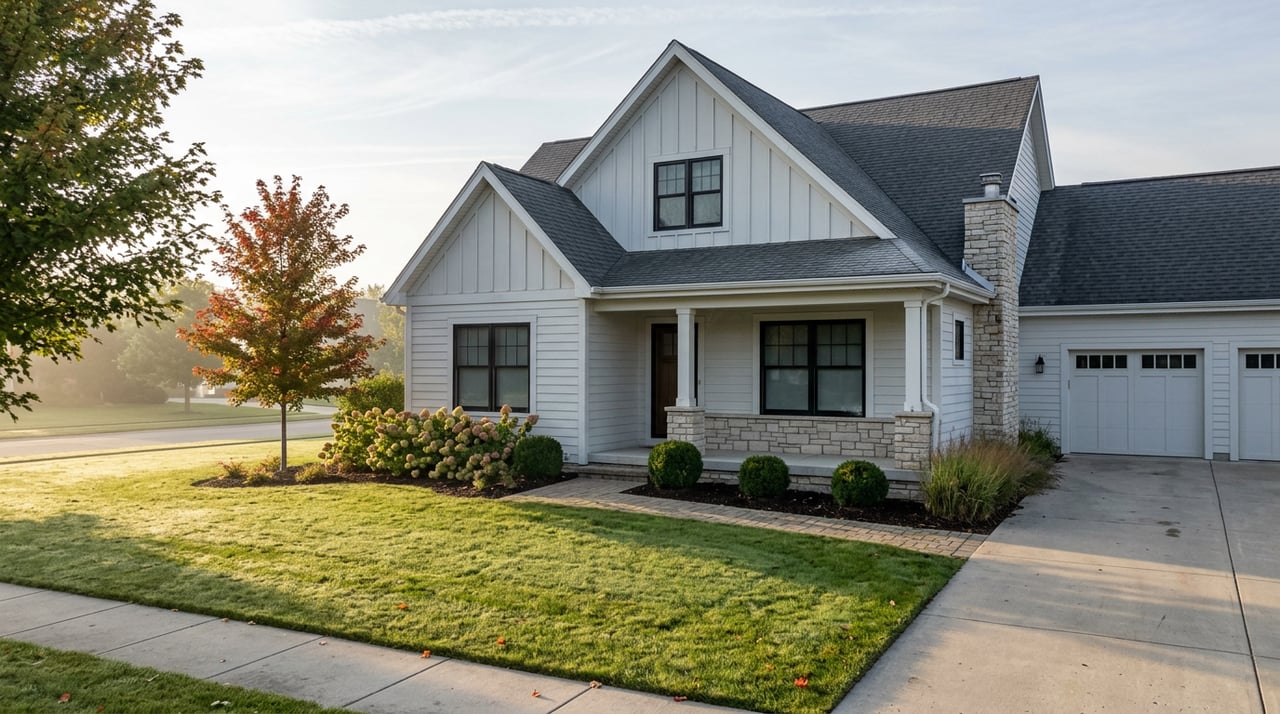
Walk into a model home in Kettlestone Ridge or the Villas at Kettlestone this month and ask the builder's rep a simple question: does this house have a passive radon system built into the slab. You will likely get one of two answers. Either a confident yes, because plenty of builders already do this as standard practice, or a pause, because the person in front of you has heard the same headlines you have and isn't entirely sure what the new law actually requires yet.
That pause is the story. Iowa passed a law this year that sounds like it settled the question. It didn't, not yet, and the gap between what the law says and what it currently requires matters most in exactly the kind of place where new construction is happening fastest: Waukee.
A Law That Isn't a Rule Yet
Governor Reynolds signed House File 2297 on May 19, 2026, and it took effect July 1, 2026. The bill's language is direct: the state building code commissioner is to adopt a requirement that new single-family and two-family residential construction include a passive radon mitigation method, drawn from Appendix AF of the 2021 International Residential Code. Coverage of the signing described it as a law requiring radon mitigation in all new Iowa homes, and Rep. Austin Baeth, D-Des Moines, called it a rare chance to pass legislation that will directly save lives.
Here's the part that didn't make the headlines. On June 25, 2026, the Iowa Department of Inspections, Appeals, and Licensing clarified how the law will actually be enforced, and the answer is: not yet. According to Fred Law's summary of the guidance, HF 2297 requires the building code commissioner to add the radon mitigation requirement to the state building code, but it does not by itself create an enforceable requirement. The mandate will apply once the code is amended, and only to construction that commences after that amendment happens. As of DIAL's late-June clarification, that amendment had not yet been adopted, and no adoption date had been announced. The law is real. The rule isn't in force yet.
That distinction is easy to lose in a market where new construction moves fast and a lot of buyers assume state law and site inspection move in lockstep.
A law that tells a future commissioner to write a future rule is not the same as a rule a builder has to follow on the house you're standing in today.
Why Dallas County Was Never on the List
Here's the piece that makes this a Waukee story specifically, not just an Iowa story. Before HF 2297, Iowa didn't leave radon-resistant construction entirely to chance. Eleven jurisdictions had already written radon-resistant new construction into their own local codes: the counties of Bremer, Johnson, Linn, and Polk, plus the cities of Altoona, Bondurant, Carroll, Iowa City, North Liberty, Norwalk, and Pella, according to Iowa HHS's radon resources page.
Dallas County isn't on that list. Waukee sits in Dallas County. So a spec home framed last year in Kettlestone Ridge, Parkside, or Prairie Rose was under no local mandate to include a passive radon system, and a spec home framed this summer in Mallard Prairie or Painted Woods West still isn't under a state mandate, because the code hasn't been amended. Neighboring Polk County already requires it under its own local code. Waukee has not.
None of this means Waukee builders skip it. Legal coverage of the new law noted that most homebuilders already install passive radon mitigation systems as standard practice, which is why the law is expected to have limited practical impact on the industry overall. That's a reasonable expectation for builders who've made it routine. It is not a guarantee for every lot, every builder, and every home currently under construction in a county that was never required to check.
The Other Half of the Problem: Iowa's Disclosure Law Rewards Not Testing
There's a second piece of this that catches buyers off guard even on resale homes, and it compounds the new-construction question rather than solving it.
Iowa Code chapter 558A requires sellers to disclose known material facts about a property, and radon is one of the specific items on the state's standard disclosure form. But the obligation is narrower than most buyers assume. A seller has to disclose the results of a radon test only if a test was actually performed. Iowa's law does not require a seller to test for radon before selling in the first place.
Think through the incentive that creates. A homeowner who never tests has nothing to disclose and no negotiating leverage lost. A homeowner who tests and gets an unwelcome number now has a document trail. Multiple legal summaries of the law note this directly: the disclosure requirement can discourage testing, because people who test may not want to be the ones who have to report it. The safest paperwork move, ironically, is to never find out.
For a Waukee buyer, that means the "seller disclosed no radon issues" line on a resale listing tells you almost nothing. It could mean the home tested clean. It could mean nobody ever tested. Iowa's own numbers make that distinction worth caring about. The state's radon survey found that 71.6% of Iowa homes sit above the EPA's action level, the highest share of any state, against a national average indoor level of 1.3 picocuries per liter compared with Iowa's statewide average of roughly 8.5. All 99 counties, Waukee's included, carry the EPA's Zone 1 designation, its highest risk category.
What It Actually Costs to Get Ahead of This
The dollar difference between building it in and fixing it later is the clearest argument for asking now rather than testing after you've moved in.
| When it happens | What it involves | Typical cost |
|---|---|---|
| During construction | Passive system: gravel layer, vent pipe, sealed penetrations, roughed-in electrical junction box for a future fan | $250 to $750, sometimes less if the builder already uses similar techniques for moisture control |
| Short-term test at inspection | Continuous radon monitor placed for 48 hours, typically bundled into a home inspection | $150 to $250 |
| Retrofit after high test result | Sub-slab depressurization system installed after the fact, in Waukee specifically | $800 to $2,000, with most standard basements landing in the $1,000 to $1,500 range |
The passive components cost a builder a few hundred dollars to install while the slab is open. Retrofitting the same protection after drywall, flooring, and finished basements are in place runs two to three times as much, sometimes more depending on the foundation. That gap is the entire economic argument for asking the question before you sign rather than testing after closing and hoping for the best.
What to Ask Before You Sign in Waukee
If you're touring new construction in Kettlestone Ridge, the Villas at Kettlestone, Painted Woods West, Mallard Prairie, or any other community currently building in Waukee, a few direct questions get you further than the marketing brochure will:
- Does this specific home include a passive radon vent pipe and sub-slab gravel layer, or is that an optional upgrade?
- Is there a roughed-in electrical junction box in the attic in case a fan needs to be added later?
- Can I get the radon-resistant construction detail in writing as part of the purchase agreement, not just a verbal answer from the sales office?
- Will the builder allow a radon test as part of my home inspection, and will they address results above 4.0 picocuries per liter before closing?
None of these questions require the state code amendment to exist. They just require you to stop assuming the new law already answered them for you.
If You Already Closed
If you bought a new construction home in Waukee any time before this law fully takes effect, whether that was last year or last month, nothing about your home changed on July 1, 2026. The law isn't retroactive even once it's enforced, and it only reaches construction that commences after the code amendment is adopted. A short-term radon test, the same $150 to $250 kind used during a purchase inspection, is the only way to know where your specific home actually stands. If the number comes back above 4.0 picocuries per liter, a retrofit mitigation system is a known, bounded cost rather than an open question, and it's one that's simpler to solve on your own timeline than in the middle of a future sale.
Frequently Asked Questions
Does this law apply to homes that are already built or currently under contract? No. The requirement, once the state building code is actually amended, will apply only to construction that commences after that amendment. Homes already built or currently framing in Waukee are not covered retroactively.
Is a radon test required to sell a home in Iowa? No. Iowa law requires sellers to disclose radon test results if a test was performed, but there is no requirement to test before listing a property.
How do I know if my new construction home in Waukee already includes radon-resistant features? Ask the builder directly and request written confirmation of what's included, since Dallas County was not one of the jurisdictions that required this before the new state law, and the state requirement is not yet enforceable.
Whether you're comparing new construction communities in Waukee or trying to make sense of a disclosure form on a resale listing, the questions that protect you are rarely the ones covered in a builder's brochure. If you want a second set of eyes on a purchase agreement, an inspection report, or a spec home you're considering, Ingrid Williams Real Estate Team is ready to help you start your next move with the full picture in hand.