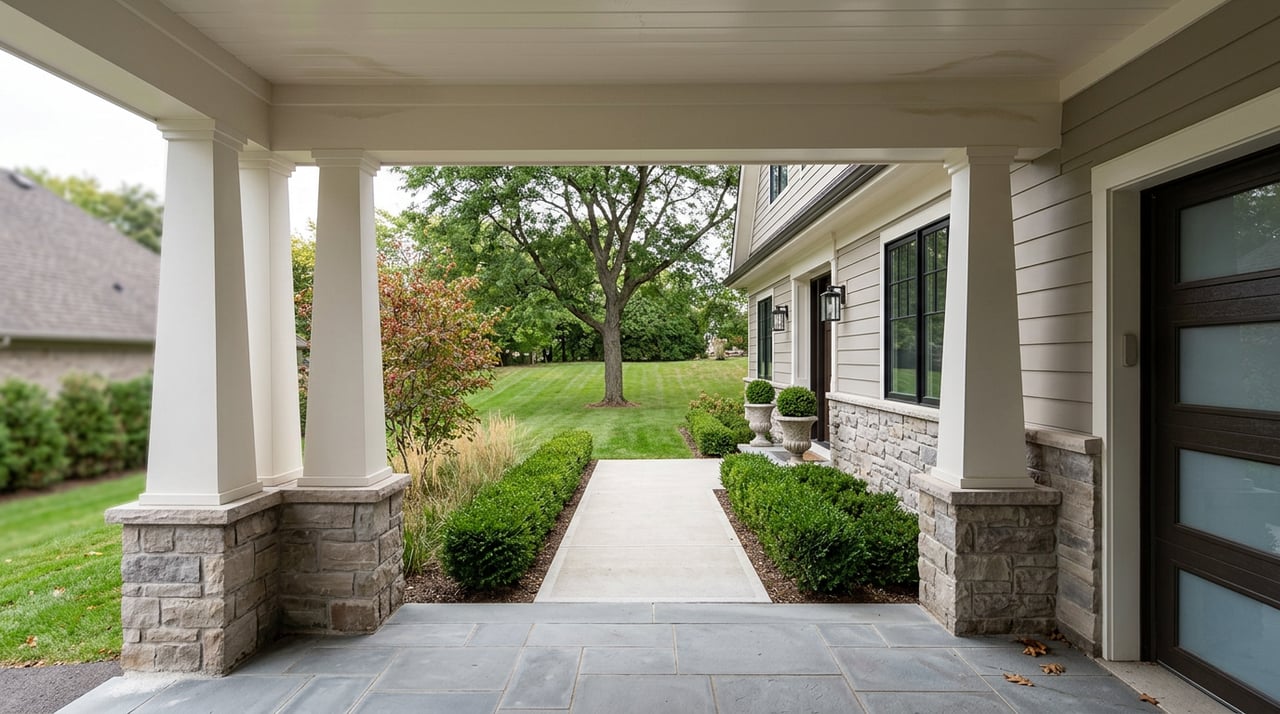
Drive down almost any residential street in West Des Moines and nothing marks where one county ends and another begins. No sign, no fence, no change in the pavement. Two houses on the same cul-de-sac, built by the same developer in the same year, can sit in different counties, feed different school systems, and land on different tax bills. The street address gives no hint. Only the parcel number tells the truth.
That invisible line is not a curiosity. It is one of the more consequential facts a buyer or seller in this city can miss, and it rarely shows up until closing paperwork, a tax statement, or a school enrollment call forces the question.
A City Split Four Ways
West Des Moines is not one taxing jurisdiction pretending to be simple. According to the city's own finance department, West Des Moines spans four counties, Polk, Dallas, Warren, and Madison, and that split produces nine different total tax rates across the city. Each of those rates is built from the same basic pieces: a city levy, a county levy, a school district levy, and smaller assessments from entities like Des Moines Area Community College. The city sets its own piece. It has no authority over what the county or the school district decides to charge on top of that.
A few years back, this played out in a very visible way. When Dallas County voters approved a Local Option Sales and Services Tax, the city lowered its own portion of the property tax rate from $12.00 to $11.79 per $1,000 of valuation, as promised. When Polk County voters later approved the same local-option tax, the city trimmed its rate again, down to $10.99 per $1,000. Two rate cuts, both real, both delivered on schedule. But the city was upfront that a lower city rate does not guarantee a lower total bill, because the county and the school district set their levies independently and can move in the opposite direction. Four counties, each running its own budget process, means four sets of decisions layering onto whatever the city does.
The School Boundary Hiding Inside the Tax Boundary
The county line does more than shuffle numbers on a levy sheet. It also determines which school district a home is zoned into, and in West Des Moines that boundary does not follow the city limit the way most buyers assume.
Most of West Des Moines sits in Polk County and is zoned to West Des Moines Community School District, which runs eight elementary schools, two junior highs, and Valley High School, along with a freshman-only campus at Valley Southwoods. The Dallas County portion of the city is a different assignment entirely. It falls under Waukee Community School District, and three of that district's ten elementary schools sit physically inside West Des Moines city limits. A family can buy a home with a West Des Moines mailing address and a Waukee school assignment, and nothing on the listing sheet will flag the difference.
Here is a snapshot of how the two dominant slices of the city compare:
| Polk County side | Dallas County side | |
|---|---|---|
| School district | West Des Moines CSD | Waukee CSD |
| Schools serving the area | 8 elementary, 2 junior high, Valley HS, Valley Southwoods | 3 of Waukee's 10 elementary schools sit within WDM limits |
| Assessment notice timing | Typically mailed by mid-March | Typically mailed by mid-April |
| Who sets the assessed value | Polk County Assessor | Dallas County Assessor |
None of this is a reason to avoid one side of the city or the other. It is a reason to confirm the assignment directly with the district before assuming anything based on the name on the address.
Why Two Tax Calculators Disagree About Your Own Address
Search for property tax rates in this market and you will find numbers that do not agree with each other, and the disagreement is not an error. It is a methodology problem hiding in plain sight.
Broad, countywide estimates put Dallas County's effective property tax rate around 1.32 percent and Polk County's around 1.51 percent, numbers pulled from every parcel in each county, rural land and small towns included. City-specific data tells a narrower story. Looking only at West Des Moines addresses, one tax-data aggregator puts the median effective rate on the Polk County side around 1.53 percent, and on the Dallas County side closer to 1.63 percent, essentially reversing the gap the countywide averages suggest. Even within the Polk County portion of the city alone, the same aggregator found a real spread, from a median effective rate of 1.53 percent in the 50265 zip code to 1.58 percent in 50061, a difference tied to which school levy and special assessment district a given subdivision falls under.
The lesson is not which number is right. It is that a countywide average was never built to answer a question about one address. If you are budgeting a monthly payment around a tax estimate, pull the figure tied to the actual parcel, not a county-level number that averages in land you will never own.
The Calendar Nobody Mails You Twice
Iowa gives every property owner in the state the same statutory window to challenge an assessed value: April 2 through April 30, set by Iowa Code section 441.37 and enforced the same way in every county's board of review process. What is not the same everywhere is how much runway you get to build a case before the appeal deadline.
On the Polk County side of West Des Moines, assessment notices typically arrive by mid-March, giving owners several weeks to prepare before the April 30 appeal deadline. On the Dallas County side, notices tend to land closer to mid-April, leaving less time to prepare before that same deadline. Same statewide deadline, different amount of warning. For anyone who bought recently and suspects a new assessed value overstates the home's worth, knowing which county's calendar applies is the difference between having time to pull comparable sales and scrambling in the final week.
According to Property Tax Due Dates, Iowa also bills property taxes a year behind. The two installments due each year, September 1 and March 1, cover the prior fiscal year's assessment. That timing shows up at closing as a proration credit or debit on the settlement statement, calculated against whatever levy applied to that specific parcel, county line and all.
A West Des Moines address tells you the mailing city. It does not tell you the taxing authority, the school assignment, or the assessment calendar. Only the parcel number does that.
The One Line That Doesn't Change
Amid all this variation, one closing cost stays exactly the same no matter which county a West Des Moines home sits in. According to PropCash, Iowa's real estate transfer tax runs $0.80 per $500 of consideration, roughly 0.16 percent of the sale price, and by custom it is paid by the seller. It is a small, predictable line on the settlement statement, and it is worth knowing precisely because almost nothing else about a West Des Moines transaction is that consistent.
Before You Write an Offer Near the Line
A short list worth working through before an offer goes in on any West Des Moines property, especially one near a county boundary:
- Confirm the parcel's county directly through the Polk County Assessor or Dallas County Assessor, not just the city listed on the mailing address.
- Confirm the school district assignment directly with the district rather than assuming based on the city name.
- Ask the current owner or listing side for the most recent assessed value and whether a homestead credit is on file.
- Ask when the next assessment notice is expected to arrive for that specific parcel, so you know how much time you would have to review it.
- Treat any national or countywide tax calculator as a starting estimate only, then verify against the parcel's actual record before finalizing a budget.
A Couple of Quick Answers
Does buying in West Des Moines mean my kids will attend West Des Moines Community School District? Only if the parcel sits in the Polk County portion of the city. The Dallas County slice is zoned to Waukee Community School District, which includes three of that district's ten elementary schools. Confirm the exact assignment before assuming based on the city name on the address.
Why do two online tax calculators show different numbers for the same neighborhood? Broad calculators often average an entire county, folding in rural land and other towns, while city-specific tools isolate West Des Moines addresses. Even those can differ by a percentage point or more depending on the zip code, school levy, and special assessment district involved. The only number worth budgeting against is the one tied to the actual parcel.
West Des Moines rewards buyers and sellers who ask about the parcel, not just the city name on the sign. If you are weighing an offer near one of these boundaries, or pricing a listing that sits close to one, the Ingrid Williams Real Estate Team can pull the specific county, school assignment, and assessed value tied to that address before you sign anything. Start Your Next Move with a conversation grounded in the parcel record, not a countywide average.
This article is general information, not legal, tax or financial advice. Consult a qualified professional about your situation.